
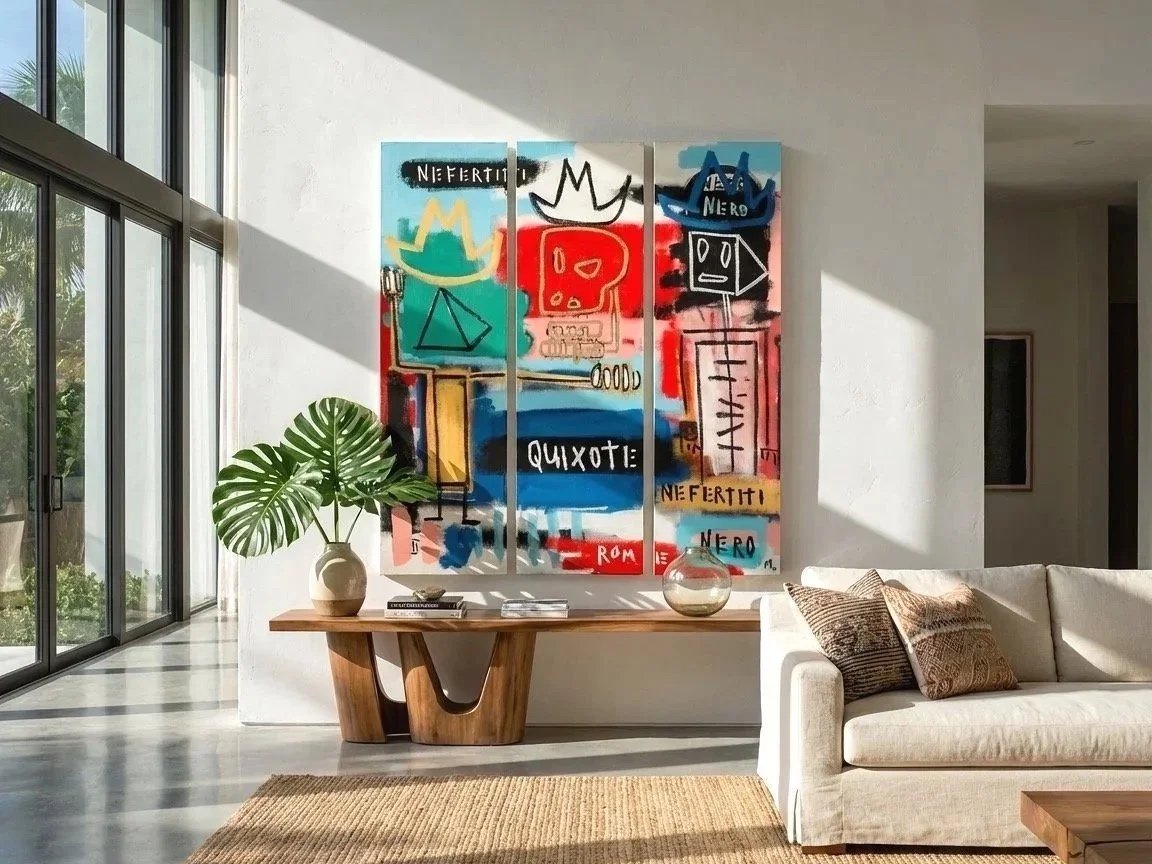
Fall of Rome Tryiptch
A word can be a very small thing to carry a very large amount of baggage.
Someone says a name, and you’re back in a room you haven’t thought about for years. You read a sentence and hear it in somebody else’s voice. An ordinary word becomes funny, uncomfortable or deeply personal because of the history you’ve attached to it.
I’m fascinated by words — what they mean, our connection to them, and the attachments we place upon them.
Words appear throughout my work, alongside figures, marks and symbols. Sometimes you can read them immediately. Sometimes they’re interrupted, obscured or caught up in everything happening around them.
They don’t always arrive to explain the painting. Quite often, they make it more complicated.
Which, admittedly, does seem to be a recurring habit of mine.
We’re used to reading words for instructions. We look for a message, a conclusion, something that tells us what to think. Put a word inside a painting, though, and its surroundings begin to interfere.
Its size matters. Its position matters. So does the image beside it.
A familiar word can suddenly feel unfamiliar. A fragment can send your thoughts somewhere the rest of the painting hasn’t been. You might connect two things simply because they happen to share a space.
I’m interested in those connections, particularly the ones that seem to happen before we’ve consciously decided to make them.
The same is true of symbols. We recognise something and bring our own associations to it. A shape that means one thing to me may carry an entirely different history for you.
That’s part of the conversation.
I can tell you about the materials, the marks and the ideas I was thinking about. I can give you a way into the work. But I can’t supply your memories, and I wouldn’t want to.
Sometimes a word is the first thing that draws you towards a painting. You read it, look around it, then notice something you would otherwise have missed.
Sometimes it refuses to make sense at all.
You’re allowed to stay with that uncertainty for a while. There is no examination at the end.
I like the possibility that a word can become an image, an image can suggest a memory, and a memory can change what you thought you were looking at.
All that from a few letters.
Quite a lot of trouble for something so small.