
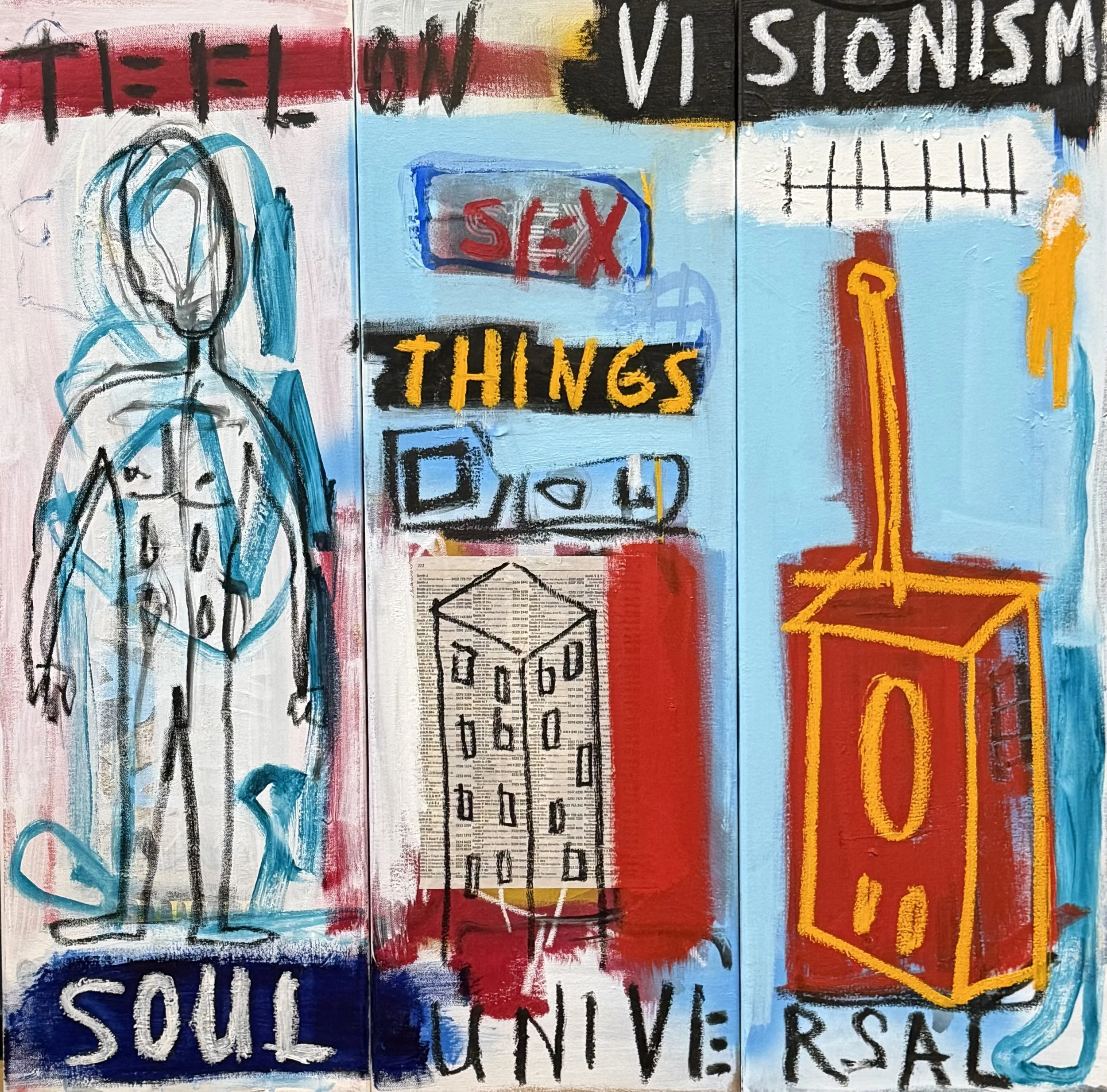
Teflon Sex Things (triptych) By M.
Visionism is the name I use for my approach to making and looking at art. It centres on perception: what we see, the meaning we give it, and why we arrive at that meaning in the first place.
I created the label partly because I wanted room to develop my own visual language and mythology, without having the work squeezed into somebody else’s description.
Of course, creating a label to avoid labels has its own little irony.
I can live with that.
It begins with the image
I rarely start with a complete picture of what a painting will become. A mark leads to another mark. Words, figures and symbols begin to form relationships. I follow the image as it develops, trying to bring it close to completion before it becomes something else.
There are decisions throughout that process, but there isn’t a fixed plan waiting to be filled in.
Sometimes I understand a connection while I’m painting. Sometimes I notice it much later. Sometimes another person sees something that had never occurred to me.
That last part matters.
The viewer brings something too
A symbol doesn’t carry exactly the same associations for everyone. Neither does a word, a colour or a face.
You bring memories and experiences I don’t have. You might recognise something I overlook, or feel something quite different from what I felt while making the work.
Visionism leaves room for that encounter. The question extends beyond identifying what is pictured. I’m interested in why a particular image catches your attention, and what happens when you spend time with it.
You don’t need to decode every mark to have a relationship with a painting.
A language that keeps developing
Certain images and ideas return across my work. They form connections between paintings, but their meaning can shift with their surroundings.
I think of that language as something I am still developing. A finished painting becomes part of a larger body of work, and the next painting may bring another part of it into view.
So Visionism isn’t an answer sheet I can hand you before you enter the gallery.
It is a way into the conversation.
Look at the work. Notice what draws you in. Give yourself permission to change your mind.
Then ask yourself: why did I see that?